Courses / Prompting Basics / Lesson 1 of 6
The R.I.C.K. Model
Why most AI answers disappoint, why prompting is really communication, and the four-part R.I.C.K. Model (Role, Instructions, Context, Key Output) that fixes it.
Start with a complaint you’ve probably heard
Here is the most common thing people say about AI tools:
“I tried it. The answer was garbage. It didn’t give me what I wanted.”
And here is the most common reason that happens: they typed one vague line and expected a great answer.
When you type “help me with my report” or “write me something for work,” you aren’t really giving the AI a prompt. You’re giving it a guess. AI is very good at guessing, but it can only guess from what you gave it, and you gave it almost nothing. So you get almost nothing back. Or worse, you get something that looks finished but completely misses the point.
Most people blame the tool. The tool is rarely the problem. The instruction is.
“The quality of your AI output is a direct reflection of the quality of your instruction.” — Rick Pride, Rage with the Machine
Prompting isn’t magic. It’s communication.
“Prompt engineering” sounds technical, like something only programmers do. It isn’t. Prompting is structured communication: giving a thinking tool enough information to actually be useful.
You already do this with people every day. You give a friend directions to your house. You explain a problem to a doctor. You tell a barber exactly how you want your hair cut. In every case, the result depends on how clear you were.
AI is no different, with one big exception: AI has no relationship with you. It has no shared history, it can’t read between the lines, and it starts fresh every single time with exactly what you give it and nothing more. A friend who’s known you for years can fill in your gaps. AI can’t.
Think about it: What’s something you could ask a close friend in five words that you’d need fifty words to ask a stranger? That gap is exactly what a prompt has to fill.
The pizza order
Imagine walking into your favorite pizza place, sitting down, and telling the server:
“Give me food. I’m hungry.”
They might bring you something. They might bring breadsticks when you wanted a full pie. Whatever arrives, there’s a good chance it isn’t what you actually wanted, because you never said what you actually wanted.
Now imagine you say:
“Large pepperoni. Extra pepperoni. Add bacon and jalapeños. And put it in a box, I’m taking it to go.”
You get exactly that. Every time.
That’s prompt engineering. You’re not writing code. You’re placing an order. The more specific and complete the order, the more likely you get exactly what you need. The R.I.C.K. Model is your ordering system.
The R.I.C.K. Model
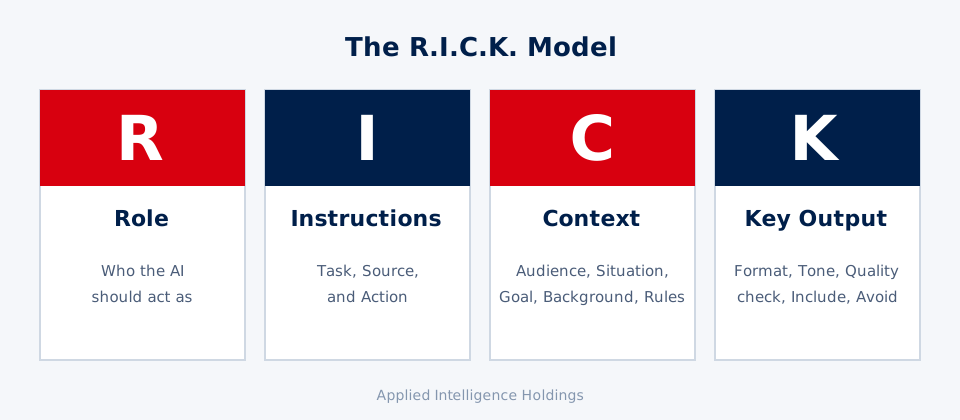
R.I.C.K. is a four-part framework. Each letter is a section of your prompt, and each section has a few supporting fields that make it work.
| Letter | What it covers | The supporting fields |
|---|---|---|
| R — Role | Who the AI should act as | The perspective, expertise, and mindset |
| I — Instructions | What to do | Task · Source · Action |
| C — Context | The background it needs | Audience · Situation · Goal · Background · Constraints and rules |
| K — Key Output | What a good answer looks like | Format · Tone · Quality check · Include · Avoid |
Every strong prompt covers all four sections. Every weak prompt is missing at least one.
The supporting fields aren’t separate from R.I.C.K.; they live inside it. They’re the details that make each letter do its job. You’ll learn each section in depth over the next three lessons:
- Lesson 2: Role and Instructions
- Lesson 3: Context
- Lesson 4: Key Output
A first look: weak prompt vs. R.I.C.K. prompt
Weak prompt:
“Help me organize my tasks.”
The AI doesn’t know what your tasks are, how much time you have, what matters most, or how you like to work. It will give you generic productivity advice you’ve heard a hundred times.
R.I.C.K. prompt:
ROLE:
You are a productivity coach who helps busy students prioritize and focus.

INSTRUCTIONS:
- Task: Review my task list and sort it into three categories.
- Source: The task list I have pasted below.
- Action: Categorize each item as: Must Do Today | Schedule for Later | Delegate or Drop.

CONTEXT:
- Audience: Me, a high school junior with a part-time job.
- Situation: I have about 6 hours of free time this week, spread across three evenings.
- Goal: Finish the week without missing Friday's history project deadline.
- Background: The history project is worth 25% of my grade. Everything else is secondary this week.
- Constraints: Don't combine tasks or add new ones. Work only with my list.

KEY OUTPUT:
- Format: A simple table with three columns, one per category.
- Tone: Direct and practical.
- Quality check: Make sure every item is placed and no item appears twice.
- Include: A one-sentence reason for anything placed in Delegate or Drop.
- Avoid: Generic productivity advice. Only categorize what's on the list.
Why it works: The AI knows the role, the task, the source material, the exact action, the audience, the situation, the priority, the limits, the format, and what “good” looks like. There’s nothing left to guess.
Yes, it’s longer. It took about two minutes to write. But it replaces ten minutes of reading a useless answer, rewriting the prompt, and trying again.
Prompting is leadership
Here’s something most AI guides skip: giving a strong prompt is an act of leadership.
Think about what good leaders do. They don’t walk into a room and say, “Do something useful.” They:
- Define who should do the work and from what perspective. (Role)
- Specify the task, the materials, and the exact action required. (Instructions)
- Explain the audience, the situation, the goal, the background, and the rules. (Context)
- Describe what success looks like before the work begins. (Key Output)
Then they review the result and give feedback.
That’s exactly what R.I.C.K. does. If you’ve ever captained a team, run a group project, trained a new coworker, or explained a job to someone, you already have this skill. You’re just applying it to a different kind of collaborator, one that never gets frustrated when you revise the brief.
Think about it: Picture the best teacher, coach, or boss you’ve had. How did they explain what they wanted? What did the worst one do differently? Which one do your prompts sound like right now?
Think deeper: why structure works on a prediction machine
In AI Fundamentals, you learned that a language model writes by predicting the most likely next words based on everything in front of it. That one fact explains why R.I.C.K. works so well.
When your prompt is vague, many different answers are equally “likely,” so the model picks the most average, middle-of-the-road one. That’s why vague prompts produce answers that feel like they were written for everyone, which means they were written for no one in particular.
Each part of R.I.C.K. narrows the possibilities:
- A Role pulls the prediction toward the vocabulary and priorities of that kind of expert.
- Instructions remove the guesswork about what you’re asking for.
- Context gives it specific facts, and specific input tends to produce specific output.
- Key Output sets a target the answer must hit, including a quality check it should run on itself.
So R.I.C.K. isn’t a magic formula. It’s a way of handing the AI what it needs to predict your answer instead of an answer.
A question to sit with: If AI is just predicting the most likely response, what does that say about the value of your knowledge, your audience, your situation, and your standards? Who is really doing the most important thinking in a great prompt?
Practice: rebuild a weak prompt
- Pick a real task you have this week, or use “Help me with my report.”
- Copy the full R.I.C.K. template below.
- Fill in every field. If you don’t know an answer, that’s a sign you haven’t fully decided what you want yet.
- Run your weak prompt and your R.I.C.K. prompt in the same AI tool.
- Compare the two answers side by side.
- Reflect: Which field made the biggest difference? Which one was hardest to fill in, and why?
Copy the template below and use it on your next real task.
Prompt template
ROLE:
You are [describe the role, expertise, or perspective the AI should take].

INSTRUCTIONS:
- Task: [What needs to be done, verb first, be specific]
- Source: [What document, data, or material to use, or "no source provided"]
- Action: [The specific thing the AI must do with the task and source]

CONTEXT:
- Audience: [Who this output is for]
- Situation: [What is happening right now that makes this task necessary]
- Goal: [What success looks like when this is done well]
- Background: [Relevant facts, history, or details the AI needs]
- Constraints and rules: [What limits the work: privacy, tone, scope, compliance]

KEY OUTPUT:
- Format: [Bullet list, table, email, paragraph, numbered steps]
- Tone: [Formal, plain English, direct, warm]
- Quality check: [What the AI should verify before finishing]
- Include: [What must be in the response]
- Avoid: [What must not appear in the response]
Try it
Think of the last time an AI answer disappointed you, or use 'Help me with my report.' Rebuild that prompt using the full R.I.C.K. template below, filling in every field. Run both versions. Then answer this: which missing piece made the biggest difference?
Key takeaways
- Weak AI answers are usually a communication problem, not a tool problem.
- Prompting is placing an order: the more complete the order, the more likely you get what you need.
- R = Role: who the AI should act as.
- I = Instructions: the Task, the Source, and the Action.
- C = Context: Audience, Situation, Goal, Background, and Constraints.
- K = Key Output: Format, Tone, Quality check, what to Include, and what to Avoid.
Pass the knowledge check to complete this lesson.